


Clinical Updates
Best Care Anywhere
Innovative care, state-of-the-art diagnostic equipment, successful clinical trials, and specialty clinicians are taking UC Davis to unparalleled heights in clinical care.
Minimally Invasive Treatment for Liver Disease
Dr. Bill Culp, chief of the Soft Tissue Surgery Service, developed a novel treatment for intrahepatic portosystemic shunts (IHPSS) more than a decade ago. IHPSS is a congenital abnormality of blood vessels that prevents blood from effectively getting to the liver. In a procedure known as percutaneous transvenous coil embolization (PTCE), extraneous blood vessels are sealed off and blood flow is redirected to liver tissue, allowing it to grow and resume its normal function of removing toxins from the blood.
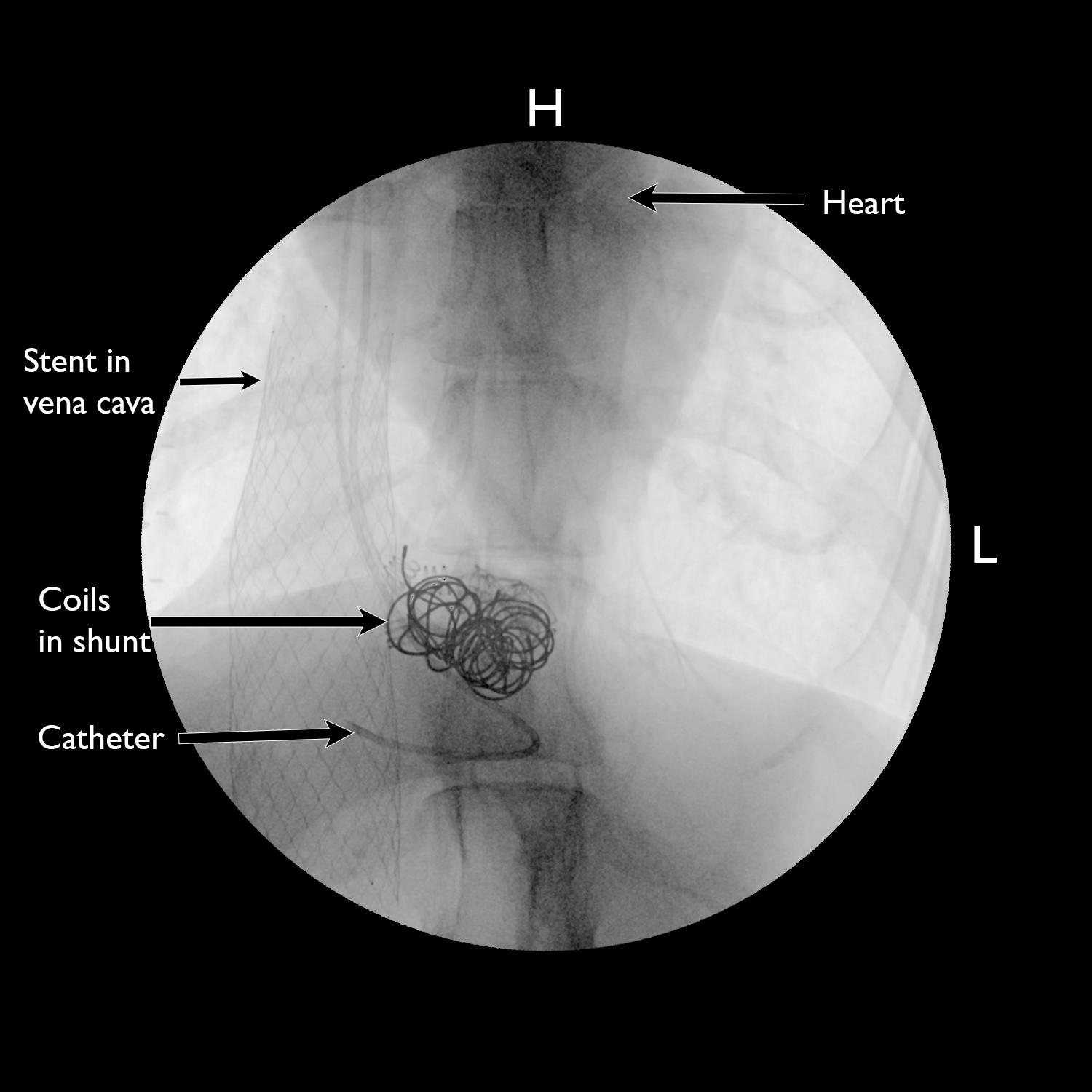

PTCE is minimally invasive, using interventional radiology (real-time x-ray guidance) techniques. The entire procedure is performed in the neck region through a small puncture in a blood vessel, making recovery quicker and more comfortable.
Culp published the first prospective trial on the use of PTCE to treat IHPSS in 2017, with promising results. That trial demonstrated that PTCE treatment of IHPSS was effective in 92% of dogs, and they were able to be taken off medical management. The procedure is now considered the treatment-of-choice at most facilities worldwide.
Culp recently treated Colonel, a 1-year-old Irish Wolfhound. While the disease can be diagnosed in any dog, the incidence within Irish Wolfhounds is noteworthy; several studies have shown it to be a familial disorder likely genetic in origin. Colonel’s owner reports he is in great spirits since his successful surgery.
Culp has published several papers on IHPSS that have led to the advancement of procedures like PTCE as the standard of care for the disease. As he treats more Irish Wolfhounds with IHPSS, a database of patients will be established with the goal of further researching both IHPSS and PTCE for that specific breed.
New Insight into Equine Neurology Cases
With the opening of the All Species Imaging Center last year, the UC Davis veterinary hospital is quickly establishing itself as the nation’s premier diagnostic and treatment center for equine neurological conditions. The center’s new large bore standing CT scanner, along with an MRI large enough to accommodate a horse, allow large animal clinicians and imaging specialists to capture images of additional body parts and/or capture them in a safer and quicker manner.

“With the standing CT, we no longer have any potential risks from general anesthesia when scanning a horse,” said Dr. Monica Aleman. “Even healthy horses can be injured during anesthesia recovery. We are minimizing that risk now.”
Ducky, a 6-year-old Thoroughbred gelding, recently benefitted from this advancement. His temporohyoid osteoarthropathy (THO) was discovered through a quick standing CT. This progressive disease causes bony overgrowth and fusion of the temporohyoid joint that links the skull to the hyoid bones near the jaw. This can lead to nerve damage, facial
paralysis, head tilting, balance issues, and severe head shaking. THO may be caused by infection, inflammation, trauma, or arthritis. While endoscopy has been useful for the diagnosis, a CT is needed for a definitive diagnosis.
With the standing CT, that procedure has now gone from hours under general anesthesia and a conventional CT scanner, to much less time using mild sedation and walking horses like Ducky into the standing CT. Ducky’s need for a CT was due to lameness and coordination issues, but it also discovered the unrelated THO. Thankfully, neither of the conditions currently require surgical intervention, but Aleman now has a clearer picture of his overall health and can plan accordingly should things change.
“There are so many examples of how this CT and the new MRI have completely changed the way we diagnose and treat horses with neurologic diseases and disorders,” said Aleman.
Myelograms are now faster and more accurate. These specialized imaging tests use contrast dye to detect spinal cord compression, stenosis, disc disease, foraminal stenosis, tumors, and spinal leaks. MRIs can now be utilized to scan the brain of horses to study epilepsy and other disorders. Combined with electroencephalograms to measure electrical activity in the brain, these analyses set UC Davis apart as one of the few veterinary hospitals able to complement imaging with electrodiagnostics in large animals.
Integration of this technology with the school’s Neuromuscular Disease Laboratory (NDL)—with their expertise in processing and interpretating muscle and nerve samples—adds to the clinical veterinarians’ ability to diagnose and treat patients with suspected neuromuscular disease. The NDL also collaborates with human medicine neurologists to help understand the application of human disease treatments into animals, especially important when an already discovered human disease is identified for the first time in animals.
“All of these elements showcase the uniqueness of UC Davis,” said Aleman, the first veterinarian trained and board certified worldwide in both large animal internal medicine and neurology. “There is no other veterinary hospital with our combination of diagnostic tools and imaging modalities in equine neurology.”
Brain Tumor Clinical Trial Is Latest Neurosurgical Advancement

Luna is back to work as a certified therapy dog—bringing her calm nature to healthcare centers, schools, airports, and other places—after neurosurgery to remove a difficult-to-access brain tumor. The 9-year-old Maltese was the first patient enrolled in a clinical trial investigating fluorescence-guided surgery to remove canine brain tumors.
After multiple seizures, Luna had been diagnosed with a brain tumor following an MRI with a neurologist in Southern California. She was referred to the Neurosurgery Specialty Service at UC Davis, where owner Aimee Austin met Dr. Adrien Dupanloup.
Luna’s tumor was embedded in the brain, beneath where surgeries are typically performed. The neurosurgeons reached it through a tiny incision in her cheek bone. Using a newly acquired microscope—which allows for outstanding magnification—and fluorescence technology, the tumor margins were isolated from the surrounding brain tissue, allowing for it to be thoroughly removed.

Originally suspected to be a canine meningioma—the most common brain tumor in dogs—analysis revealed it to be a choroid plexus papilloma. By participating in the clinical trial, Luna’s results will help neurologists understand the properties and behavior of this type of brain tumor and shape surgical protocols.
“It fills my heart with joy to know that the surgery and research on her tumor may help other animals in the future,” said Austin. “I always say now that she helps people when she’s well, and she potentially helped other animals when she was sick.”
Luna has not had any seizures since the surgery, and a follow-up MRI at six months showed no regrowth of the tumor.
“By expanding access to veterinary neurosurgical care and participation in clinical trials, we can improve the lives of dogs with brain tumors and create new treatment options,” said Dupanloup. “Luna’s case highlights one of the many ways that UC Davis veterinary teams support dogs and their families through close collaborations with referring neurologists who share our commitment to translational research.”
By participating in the clinical trial, Luna’s results will help neurologists understand the properties and behavior of this type of brain tumor and shape surgical protocols.
Small Animal Role Optimizes Continuity of Care
Dr. Maria Vasquez already has a favorite aspect to her position in the small animal hospital—helping manage stress for clinicians and families with hospitalized pets. By getting more hands-on time with her patients, she provides an additional resource to medical teams and reassurance to clients that the best care is being provided for their beloved pets.

Vasquez’s newly created Hospitalist Clinician role falls under the Emergency and Critical Care Service, working with patients in the Intermediate Care Ward (ICW), isolation units, and general wards. She assists primary clinicians in ensuring their patients receive optimal care, facilitating and performing procedures, participating in technician training, and helping with management of emergency room cases. Having completed an emergency and critical care residency training program, Vasquez is well prepared to provide high-level patient care and education.
“This is a vital new role,” said Dr. Kate Hopper, director of the small animal hospital. “With our busy emergency caseload, this position ensures our patients receive timely treatment and continuity of care when they transition from emergency to other specialty services.”
Often, that transition requires intermediate care, where Vasquez now takes the lead and tends to those patients’ urgent needs.
“Care of animals in the ICW and the isolation units can be quite intensive,” said Vasquez. “The hospitalist position is a new clinician role assigned directly to those inpatients, allowing the specialty clinicians to focus on their many other demands with outpatients. This allows us to give both inpatients and outpatients the attention they deserve and need.”
Vasquez points to diabetic ketoacidosis cases as prime examples of the relevance of the hospitalist position. Between their initial presentation through the ER and their transfer to the Internal Medicine Service, most of those patients are housed in the ICW and require frequent and delicate changes to their medications. Vasquez’s critical care skills and ability to focus more exclusively on these patients are an example of the enhanced patient care she can help provide in this role.
Technician support and training is another important aspect to this new position. Care in the ER and ICW requires more technician focus than in the general wards. Vasquez’s presence complements that care and adds another layer of patient safety, especially important with the critically ill patients in these hospital areas.
“The addition of Dr. Vasquez has significantly enhanced our inpatient care and improved efficiency across the specialty services,” said Dr. Michael Mison, chief veterinary medical officer.